May 2, 2026
Pressure Washing Vinyl Siding: Complete Operator Guide
An operator-grade technique guide for cleaning vinyl siding without damage: soft wash chemistry, downstream injector setup, mix ratios, nozzle selection, and pricing your first siding job.
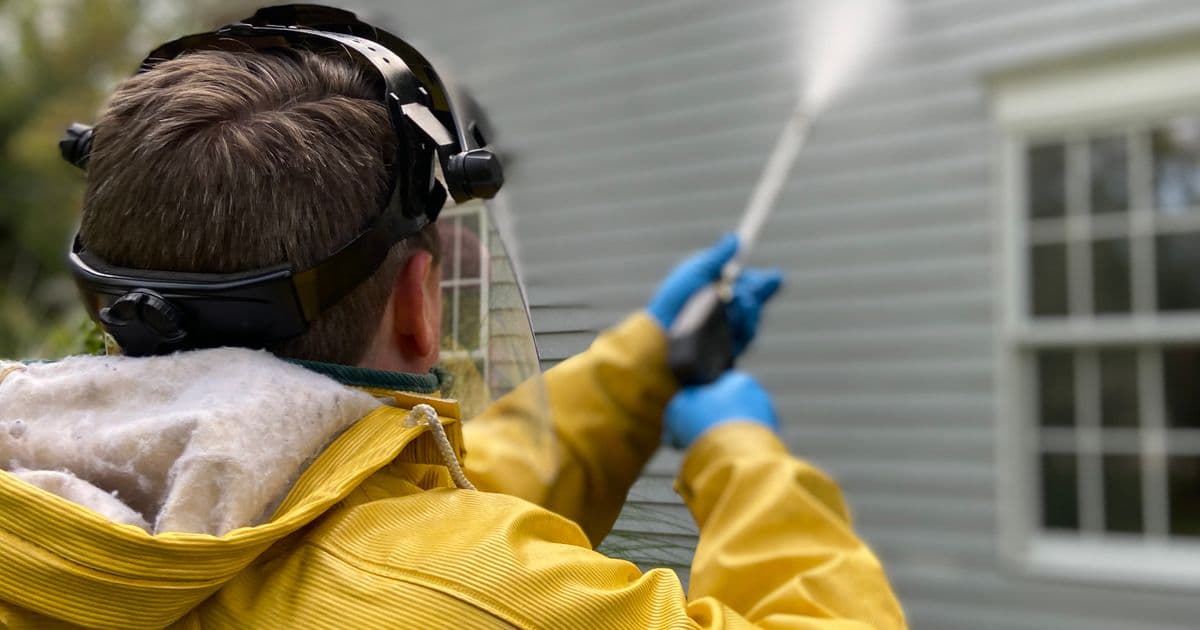
If you've damaged a vinyl panel on a job, you know exactly why this article exists. Vinyl siding is the surface where new operators get hurt — too much pressure, wrong nozzle, and you're suddenly looking at a $1,500–$5,000 panel-replacement bill on a $400 wash job. The good news: the technique is learnable and the equipment is cheap. This guide is the version we wished existed when we cracked our first panel.
Need to quote a siding job on the spot? Our free pressure washing estimate calculator (siding mode) handles soft-wash pricing automatically.
Quick answer: pressure washing vinyl siding the right way (it's not pressure)
The headline:
- Vinyl siding is soft-washed, not pressure-washed. The mildew comes off chemically, not mechanically.
- Equipment: downstream injector ($30–$80) on your existing pressure washer, or a 12V soft-wash pump system
- Chemistry: 1–2% on-surface sodium hypochlorite (SH) + surfactant (never above 2%, which damages paint and vegetation)
- Pressure: 100–200 PSI for application, 200–500 PSI for rinse (vs 3,000+ PSI for concrete)
- Nozzle: 25° (yellow) for application, 40° (white) for delicate areas, never 0° or rotary on vinyl
- Standoff distance: 12–18" for application, 6–12" for rinse, always angled downward
Doing it wrong — high-pressure rinsing, narrow nozzle, spraying upward — costs $1,500–$5,000 in panel replacement on a partial-elevation failure. (And your general liability policy almost certainly won't pay for it without a care/custody/control endorsement — see the insurance guide before you take your first siding job.) Doing it right takes 90 minutes for a typical ranch and lands at $400–$700 per house.
Why high-pressure washing damages vinyl siding
Five distinct damage modes from too-high pressure on vinyl:
- Water intrusion behind panels. Vinyl siding is designed to shed water flowing downward. A high-pressure stream angled upward forces water under the panel laps and into the wall sheathing. The damage isn't visible immediately — it shows up as wood rot 12–18 months later.
- Panel cracking. Vinyl gets brittle in cold weather. A 3,000 PSI burst on a 45°F morning will spider-crack a panel; the same burst at 80°F might just bow it. New operators learn this the hard way in early spring.
- Gouged finish. A 0° red nozzle or a turbo/rotary tip will gouge the vinyl surface — the resulting line is permanent.
- Blown caulk seals. Window and corner caulking pops out under direct high-pressure spray. The customer notices in the first rain after the job.
- Damaged window glazing. Older single-pane window seals fail under pressurized water at close range.
The single common cause: treating vinyl like concrete. Concrete is forgiving — vinyl is not.
The soft wash method explained
Soft wash inverts the assumption underneath driveway pressure washing. On concrete, pressure does the cleaning and chemistry is optional. On vinyl, chemistry does the cleaning and pressure just rinses.
The active ingredient is sodium hypochlorite (SH) — the same compound in pool shock and household bleach, but at higher concentration. SH at 1–3% on-surface kills mildew and algae at the molecular level. The mildew doesn't get blasted off; it dies, releases its grip on the vinyl surface, and rinses off with minimal pressure.
This matters operationally because:
- The job is faster. Pressure-only siding cleaning takes 3–4× longer than soft wash because you're trying to mechanically remove what chemistry could kill in 10 minutes of dwell.
- The result lasts longer. Soft-washed siding stays clean for 18–24 months. Pressure-only siding regrows mildew in 3–6 months because the spores in the surface texture survive the rinse.
- The damage risk is near-zero. At 100–200 PSI you cannot crack a panel even if you tried.
Equipment you need: downstream injector setup
The minimum-viable soft-wash kit on top of a standard pressure washer:
- Downstream injector ($30–$80) — installs between your pressure hose and the wand. Pulls chemical mix from a separate tank and adds it to the water stream at low pressure. Most pull at a 7–10:1 dilution, which is why the tank mix is stronger than the on-surface target.
- Chemical-resistant pickup hose (~$15) — runs from the injector to the tank
- Mixing tank — a 5-gallon jug minimum; many operators run a 35–55 gallon tote on the truck for bigger jobs
- Soft-wash nozzles — 25° and 40° fan tips with the right orifice size for low-pressure flow
How downstreaming actually works: water leaves your pressure washer at full pressure, hits the injector, the venturi effect pulls chemical from the tank into the water stream, and the diluted mix exits at low pressure (because soft-wash nozzles drop the pressure dramatically vs a pressure-rinse nozzle). The dilution from tank to surface is roughly 8:1 to 10:1 (varies by injector and machine GPM), which is why your tank mix has to be much stronger than the target. For a 1–2% on-surface target, that usually means running pure 12.5% SH from the jug — see the recipes in the next section.
The alternative: a 12V soft-wash pump system (~$300–$700 for entry-level units) runs the chemical mix at low pressure independent of your pressure washer. Cleaner setup for high-volume operators; overkill for occasional siding jobs. Most solo operators start with downstreaming and upgrade when soft wash becomes 30%+ of revenue.
Mix ratios: sodium hypochlorite + surfactant for vinyl
Target on-surface mix: 1–2% sodium hypochlorite plus a surfactant. Industry consensus from PWNA-certified operators clusters tightly here; the rule of thumb is 1.5% for routine soft-wash, scaling toward 2% for heavy mildew on shaded walls. Above 2%, you increase risk of paint discoloration, plant kill from drift, and slower rinse times — the math doesn't favor going higher.
Working from 12.5% pool-shock sodium hypochlorite (the standard base — household bleach at 6% is too dilute and burns up too much chemical to be cost-effective), your tank recipe depends on application method, because the math is different for each:
Spray-direct (12V pump or pump sprayer) — tank mix lands on the surface at full strength, no further dilution:
| Tank recipe (5-gal) | On-surface SH |
|---|---|
| 0.5 gal 12.5% SH + 4.5 gal water + 1 oz surfactant | ~1.25% (routine) |
| 1 gal 12.5% SH + 4 gal water + 1 oz surfactant | ~2.5% (cap at this; reserve for heavy mildew) |
Downstream injector — pulls tank mix into the pressure washer's water stream and dilutes it ~8:1 to 10:1 at the wand, so the tank has to be much stronger than your on-surface target. For routine vinyl-siding work, run pure 12.5% SH straight from the jug with surfactant added (no water dilution in tank); after a typical 10:1 downstream, that lands at ~1.25% on surface. If your injector pulls at 7:1, consider diluting the jug 3:1 (3 parts SH + 1 part water) to keep on-surface around 1.5%.
Surfactant matters more than new operators expect. It does three things: prevents the mix from streaking down the wall before it can dwell, improves the chemical's ability to penetrate the mildew structure, and keeps the chemical wet on the surface during the dwell time. Don't skip it. Common picks: Elemonator, Slosh, or any generic non-ionic soft-wash surfactant at 1 oz per 5 gal of tank.
A note on regional adjustments: the ranges above are the industry consensus and work across most US climates. Phoenix or Houston in July → reduce concentration and dwell time, since chemical will dry too fast and streak. Cold mornings under 50°F → extend dwell to 15–20 minutes rather than cranking up concentration; cold mildew releases more slowly but the chemistry still works.
Step-by-step technique: bottom-up application, top-down rinse
The full sequence for a single elevation:
- Pre-wet plants, lawn, and shrubs within 6 feet of the wall base. SH is hard on vegetation; pre-wetting dilutes any drift.
- Cover or move outdoor furniture, grills, planters. Move what's movable; cover what's not.
- Tape or cover electrical outlets, AC units, and dryer vents. Painter's tape on outlet plates is enough.
- Close all windows and double-check. Then check the second-floor windows.
- Apply mix bottom-up. Start at the bottom row of siding, work upward. Bottom-up prevents streak-loading: if you start at the top, dirt-laden mix runs down over clean panels and leaves visible streaks.
- Let dwell 10–15 minutes. Don't let the mix dry on the surface — re-mist if needed in hot weather. The dwell is when the chemistry actually works.
- Rinse top-down. Switch to a 25° or 40° fan at 200–500 PSI. Start at the top, work downward, always angle the nozzle slightly down so water doesn't drive up under panel laps.
- Re-rinse plants and grass below the wall base. Heavy water flush dilutes any chemical that drifted onto vegetation.
For a typical 2,000 sqft single-story ranch, the full sequence runs 75–120 minutes. Two-story houses double the time because of the access work — wand extensions, roof-edge angles, and the second-story rinse pass.
Get weekly operator-grade pressure washing tools
Pricing benchmarks, rate-card templates, and operator tips. One email a week. Unsubscribe anytime.
Nozzle selection and standoff distance
Color-coded nozzles by spray angle:
- 0° (red). Never on vinyl. Will gouge the finish.
- 15° (yellow w/ specific markings). Too narrow for vinyl. Stripping concrete only.
- 25° (yellow). Default for vinyl rinse. Wide enough fan to be safe at 200–500 PSI.
- 40° (white). Delicate-area work — around windows, trim, near caulking. Widest fan, gentlest impact.
- 65° (black, soap nozzle). Soft-wash application — drops pressure to ~100–150 PSI for downstreaming.
- Rotary / turbo. Never on vinyl. Same gouging risk as 0°.
Standoff distance: 12–18 inches during application, 6–12 inches during rinse. Closer than 6 inches at any pressure and you risk forcing water behind the panels; farther than 18 inches and your rinse is ineffective.
Always angle the nozzle slightly downward. A horizontal or upward angle drives water under panel laps. Even at 200 PSI, water-behind-vinyl is a real failure mode.
Pre-job checklist before applying any chemical
Before a single drop of SH leaves your tank, walk the property and verify:
- Oxidation level. Rub a gloved hand on the dry siding. If it comes back chalky-white, the siding is oxidized. Oxidized vinyl cannot be cleaned without shedding pigment — the cleaning will brighten it briefly, then leave the surface looking worse than before. This isn't a cleaning conversation; it's a replacement conversation. Walk away or clearly disclose the risk in writing before the customer signs.
- Pre-existing damage. Cracked panels, missing pieces, blown caulk. Photograph everything before you start.
- Wood-trim sections. Different chemistry approach — wood needs lower SH concentration and shorter dwell.
- Electrical hazards. Outdoor outlets, light fixtures, AC disconnect boxes. Cover all of them.
- Plant load below the wall. Heavy shrub coverage means more pre-wet, more rinse, and possibly a chemical concentration step-down.
- Window count and condition. Old single-pane windows with failing glazing get a wider standoff and gentler nozzle.
- Customer expectations. Walk them through the realistic outcome — clean, but not "new." Set the expectation before you start.
This is where the experience differential between a year-1 operator and a year-3 operator shows up. The year-3 operator catches the oxidation problem in 60 seconds and either declines the job or quotes it appropriately; the year-1 operator damages the siding and learns the lesson on a $3,000 panel-replacement bill.
Common mistakes that damage vinyl
Five mistakes that show up consistently in operator post-mortems:
- Using too high PSI. Above 500 PSI on a rinse pass is unnecessary and risky. Above 1,000 PSI is destructive.
- Using a turbo or 0° nozzle. Both will permanently mark vinyl. The fix is to lock these out of your siding-job kit entirely.
- Spraying upward. Drives water under panel laps and behind the siding. Always angle slightly down.
- Letting SH dry on the surface. Dried SH leaves visible streaks that don't rinse off. Re-mist during long dwell times in hot weather.
- Ignoring oxidation. Mistaking the chalky surface of oxidized vinyl for cleanable mildew turns a $400 cleaning job into a $5,000 replacement job.
Pricing your first siding job
Vinyl siding soft wash typically prices at $0.20–$0.35 per square foot. That's the soft-wash chemistry premium plus access work — both reasons it lands above plain concrete cleaning rates.
| House size | Typical price |
|---|---|
| 1,500 sqft single-story ranch | $300–$525 |
| 2,000 sqft single-story | $400–$700 |
| 2,000 sqft two-story | $500–$900 |
| 3,000 sqft two-story | $700–$1,200 |
Two-story houses always cost more per sqft than single-story — the access work, wand extensions, and roof-edge angles add 30–50% time to the job. Charge the upper end of the band for two-story.
Cost inputs per typical house:
- Chemical (1–2 gallons of 12.5% SH + surfactant): $10–$20
- Fuel (truck + machine): $5–$10
- Time (90–180 min depending on size and access): your full hourly cost
For the broader pricing framework — minimum-viable-rate math, surface ranges, and pricing-method tradeoffs — see driveway pricing fundamentals.
Get a real estimate for your siding
Free calculator. 30 seconds. No signup.
Branching out: roof soft wash, brick, and EIFS
Soft-wash chemistry transfers cleanly to two other residential surfaces:
- Roof soft wash. Same chemistry, different application. Stronger SH concentration (3–6% on surface), longer dwell, and you're working on a sloped surface where chemical control is harder. Highest premium-per-job in residential pressure washing ($0.30–$0.60/sqft) but real risk of chemical drift onto landscaping and serious access risk if you're walking the roof. Most operators wait until year 2 to add roof soft wash — the broader year-2 expansion playbook is in how to start a pressure washing business.
- Brick. Pressure-tolerant, unlike vinyl. Standard 25° at 1,500–2,500 PSI works for most residential brick. The exception is older brick with efflorescence (white mineral residue) — too much pressure can pit the surface and worsen the salt migration. Test a small section first.
- EIFS / stucco. Never high-pressure. EIFS is a foam-and-mesh exterior insulation system that delaminates if you push water into it. Soft wash only; standoff 18+ inches; verify the customer has EIFS rather than traditional stucco before you start.
For pricing across these surfaces, the driveway pricing guide covers the full framework — the same per-sqft logic with surface-specific rate ranges.
FAQ
What PSI is safe for vinyl siding? 100–200 PSI for chemical application, 200–500 PSI for the rinse pass. The 3,000+ PSI you use on concrete will crack panels, blow out caulk seals, and force water behind the siding within seconds. Vinyl siding is a chemistry-driven cleaning job, not a pressure-driven one — the chemical kills mildew at the molecular level, and pressure is just for rinsing.
Can you damage vinyl siding with a pressure washer? Yes, easily. Common damage modes: water intrusion behind panels (causes rot in wall sheathing), cracked panels (especially in cold weather when vinyl is brittle), gouged finish from a too-narrow nozzle, blown caulk seals around windows, and damaged window glazing. The fix is technique — wider fan, lower PSI, longer standoff, never spraying upward.
What is the best way to clean vinyl siding? Soft wash with 1–3% on-surface sodium hypochlorite plus a surfactant, applied bottom-up at low pressure (100–200 PSI), allowed to dwell 10–15 minutes without drying, then rinsed top-down at 200–500 PSI. Pre-wet plants and grass below the work area before starting; re-rinse them after.
Should you soft wash or pressure wash vinyl siding? Soft wash, every time. Pressure-only methods either fail to kill mildew (which lives in the surface texture and grows back within weeks) or damage the siding when pressure is dialed up to compensate. Soft wash uses chemistry to kill the organic growth and uses minimal pressure to rinse it away. The result lasts 18–24 months instead of 3–6.
What solution do you use to soft wash vinyl siding? Sodium hypochlorite (12.5% pool-shock concentration is the standard base — household bleach at 6% is too dilute), water, and a surfactant. A typical tank mix: 1 gallon of 12.5% SH + 4 gallons of water + 1 ounce of surfactant per 5 gallons. After downstream dilution (7–10:1), this lands on the surface at roughly 1–2% SH, which is the safe-and-effective range for vinyl.
How do you downstream soap on vinyl siding? A downstream injector ($30–$80) installs in your pressure hose between the machine and the wand. It pulls mix from a separate tank into the water stream and dilutes it 7–10:1 on the way to the surface. You mix the tank stronger than the on-surface target (1 gal 12.5% SH + 4 gal water typical) because dilution happens in the hose. Some operators use a 12V pump system instead — same end result, different equipment.
How much does it cost to pressure wash vinyl siding? $0.20–$0.35 per square foot is the standard range for vinyl soft wash. A typical 2,000 sqft single-story ranch runs $400–$700; a two-story 2,000 sqft footprint runs $500–$900 because of access. Chemical cost per house is $10–$20. For the broader pricing framework across surfaces, see our pricing guide.
Get a real estimate in 30 seconds
Free pressure washing cost calculator. 7 surface types, regional pricing band, no signup.
Open the calculatorRelated guides
How to Price a Driveway Pressure Washing Job
An operator-side guide to pricing residential driveway pressure washing jobs in 2026: rate ranges by surface, the minimum viable rate floor, a worked 600-sqft example, upsells, and when to walk away.
How to Start a Pressure Washing Business in 2026
An honest, full-first-year playbook for starting a pressure washing business in 2026: equipment budgets, licensing, first 10 customers, surviving year one, and a realistic P&L.
Pressure Washing Insurance: Cost & Coverage You Need (2026)
What pressure washing insurance actually costs: $1M general liability from $50/mo, the surface-damage gap GL won't cover, and what solo operators really need.
Pressure Washing Prices 2026: Rates Per Square Foot & Hour
2026 pressure washing rates: $0.08–$0.40/sq ft for concrete, $0.20–$0.35 for siding, $60–$100/hr — plus the minimum-rate math to price every job profitably.