May 2, 2026
How to Price a Driveway Pressure Washing Job
An operator-side guide to pricing residential driveway pressure washing jobs in 2026: rate ranges by surface, the minimum viable rate floor, a worked 600-sqft example, upsells, and when to walk away.
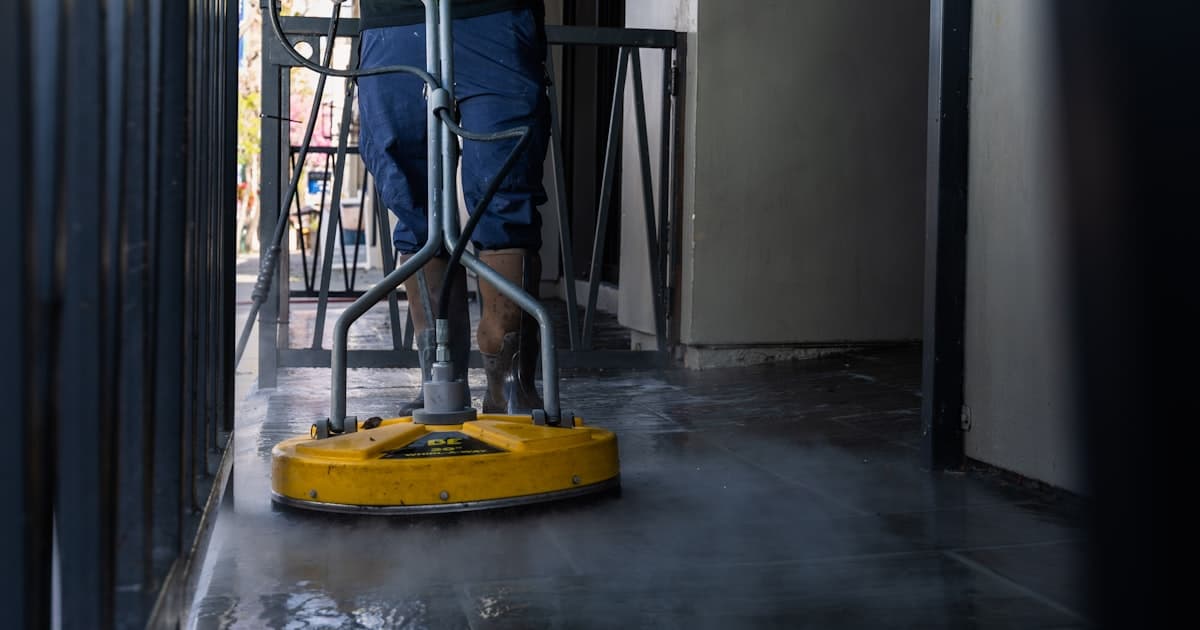
If you've ever stared at a 600 sqft concrete driveway and wondered whether you should quote $120, $200, or $250, this article is for you. Most pricing content on Google answers the homeowner's question — "what will this cost me?" — instead of the operator's question — "what should I quote?" The two are not the same number.
If you want to skip the math, our free pressure washing estimate calculator does this in 30 seconds. Otherwise, the rest of this article walks through the math step by step.
Quick answer: typical driveway pressure washing prices in 2026
| Driveway size | Typical job total |
|---|---|
| Small (400 sqft) | $150–$200 (minimum-fee territory) |
| Standard (600 sqft) | $150–$240 |
| Two-car (800 sqft) | $190–$320 |
| Long / large (1,200 sqft) | $260–$480 |
Headline numbers:
- Per-sqft rate: $0.08–$0.40 for residential driveway pressure washing in 2026
- Minimum job fee: $150–$200 — most jobs under ~750 sqft will hit this
- Add-on for oil-stain treatment: $25–$50
- Concrete sealing upsell: $0.50–$1.00 per sqft
The numbers above are job-total ranges; the deeper logic and the worked example are below.
The 3 ways to price a driveway pressure washing job
Three pricing models. Each has a clean lane:
Per-square-foot. The default for residential driveways. Measure → apply rate → check against minimum → quote the higher. Predictable, defensible against price objections, scales with the actual job size.
Flat-rate. Best for menu pricing on common job templates. "Driveway under 800 sqft: $189. Two-car driveway: $249." Closes faster on the phone because the customer hears one number, not a formula. Build the menu off your underlying per-sqft rate so you don't accidentally undercut yourself on the standard sizes.
Hourly. Almost always the wrong tool for residential driveway work. Hourly billing punishes you for being efficient — you finish the same job in half the time and bill half as much. Reserve it for time-and-materials work (graffiti, gum, restoration) where the scope is genuinely unknown.
For the broader pricing framework — including the minimum-viable-rate math behind your floor — see the 2026 industry rate guide.
How to measure a driveway accurately
Three measurement methods, ranked by speed:
- Google Earth (fastest). Open Google Earth Pro on the customer's address before the visit, use the polygon measurement tool to outline the driveway, and you have sqft within ~5% in 60 seconds. Free and works for 90% of jobs.
- Paced walk (most common on-site). A standard pace is roughly 3 feet. Pace the long edge, pace the short edge, multiply. Round up — under-measuring undercharges, and rounding up by 10% is invisible to the customer but covers the edges and any flares around the garage apron.
- Laser measure ($30 from the box store). For irregular driveways, curved edges, or anything you'd otherwise have to break into multiple rectangles. Don't bother for standard rectangular driveways — Google Earth wins.
For irregular shapes — flares around the garage, curved entrances, attached walkways — break the surface into rectangles, calculate each, and sum. Always measure the walkway separately if it's connected; some operators include it in the driveway sqft, others quote it as a separate line. Either is fine; just don't forget about it and quote it for free.
Per-square-foot rate ranges by driveway type
Driveways are not all priced the same per sqft. Surface type drives most of the spread:
| Surface | Per-sqft rate |
|---|---|
| Plain concrete (good condition) | $0.08–$0.20 |
| Aged concrete (>15 years) | $0.15–$0.25 |
| Stamped or sealed concrete | $0.20–$0.40 |
| Asphalt | $0.10–$0.25 |
| Pavers (interlocking concrete or stone) | $0.15–$0.35 |
A common point of confusion: published rates for general flat concrete sometimes go as low as $0.05–$0.08 per sqft. Those numbers are for commercial flat concrete (warehouse aprons, parking lots) — high-throughput, low-detail work. Residential driveways trend higher per-sqft because they have edges, flares, oil staining, and decorative concrete patches that all add detail-time the commercial number doesn't account for.
If you've been quoting $0.10/sqft on residential driveways because that's what some pricing article said, you're 30–50% under-market.
Worked example: pricing a 600 sqft concrete driveway
Standard suburban two-car driveway. 600 sqft. Plain concrete in average condition. One small oil stain near the garage. 15-minute drive from your route hub.
The math, line by line:
| Line | Amount |
|---|---|
| 600 sqft × $0.20 (mid-range concrete rate) | $120 |
| Oil-stain pre-treatment | +$30 |
| Drive-time premium (15 min each way, beyond standard 10) | +$25 |
| Subtotal | $175 |
| Minimum job fee check ($150 floor) | passed |
| Quote sent to customer | $175 |
Production-side gross margin breakdown for the same job:
| Line | Amount |
|---|---|
| Quote (revenue) | $175 |
| Chemicals (degreaser + light surfactant) | -$8 |
| Fuel (truck + machine) | -$10 |
| Drive time + on-site time (~75 min total at MVR $106/hr) | -$133 |
| Net contribution after time + variable costs | $24 |
That $24 is gross of equipment depreciation, insurance, and your phone — but it's not your hourly wage; the $106/hr MVR already includes your wage and overhead. The $24 is the surplus margin that lets the business reinvest in equipment, marketing, and growth. Healthy.
Now plug your driveway's dimensions into the calculator to see if your quote logic matches the worked example:
Get a real estimate for your driveway
Free calculator. 30 seconds. No signup.
For driveways outside the 600 sqft template, the same logic scales — apply rate × sqft, then check the minimum and add condition-driven adders.
Setting your minimum viable rate (the insurance floor)
Your minimum viable rate is the floor below which every job loses money. The formula:
Insurance + truck/equipment depreciation + chemicals + drive time + your hourly time = MVR
A typical solo-operator MVR breaks down to roughly $106/hr all-in. The components:
- Insurance: $50–$70/month for $1M GL is the baseline; see the insurance guide for what each policy actually covers and the GL "your work" exclusion that catches new operators off guard
- Truck + equipment depreciation: ~$18/hr combined
- Chemicals: $5–$30/hr depending on the job mix
- Drive time: ~$15/hr equivalent loss (you don't bill it but you pay for it)
- Your hourly time: ~$60/hr (what a journeyman tradesperson should earn)
That MVR is the source of your minimum job fee. A 60-minute production-time job at $106/hr MVR is $106, but the job actually consumes ~90 minutes once setup, breakdown, and a 10-minute drive are added — pushing the true minimum to $150–$200 once you include those overhead minutes.
For the full minimum-viable-rate calculation methodology, see minimum viable rate calculation.
Surface conditions that justify charging more
Walk every driveway before you quote. Five conditions that justify upcharges:
- Oil stains. Need pre-treatment with a degreaser that has 5–10 min dwell before the rinse pass. Add $25–$50 depending on stain count and severity.
- Heavy organic algae. Especially common on shaded driveways under tree cover. Adds soft-wash chemistry to the job. Add 25–40% to the base rate.
- Rust stains. Iron oxide from sprinkler systems, wrought-iron furniture, or fertilizer. Needs an oxalic-acid-based brightener after the wash pass. Add $30–$60 depending on stain area.
- Aged or oxidized concrete (>15 years). Often needs two passes — one to remove the oxidized layer, one to clean the underlying surface. Add 30–50% to the base rate.
- Stamped or sealed surfaces. Lower-pressure technique to preserve the sealer; longer dwell times with milder chemistry. Charge at the upper end of the per-sqft band ($0.30–$0.40).
The walkthrough is also when you spot conditions that warrant declining the job — see §When to walk away below.
Upsells that work on driveway jobs
The customer already has the truck and machine on-site. The marginal cost of an add-on is small; the marginal revenue is the full add-on price. Four upsells that consistently close on driveway jobs:
- Concrete sealing. $0.50–$1.00 per sqft as an add-on after the wash. Protects the surface, extends the time between washes, and the customer perceives it as a finishing service. Best timing: present at the end of the wash, while the surface is dry and the customer can see how clean it came out.
- Walkway / sidewalk extension. "We're already here — want me to do the front walkway too? $50 add-on." About 60% acceptance rate when offered.
- Garage floor. Same logic. Most garage floors are filthy, the customer has been meaning to deal with it for two years, and $40–$80 is an easy yes once the equipment is already running.
- Gutter cleaning. If you offer this — many driveway operators don't and it's a clean upsell into a complementary service. $80–$150 typical, doubles the average ticket on a driveway job.
Sequencing matters. Quote the driveway first; let the customer agree. Then introduce upsells before you start ("Quick question — while we're here, do you want us to handle the walkway and garage floor too?"). Adding upsells mid-job feels like price-creep; adding them upfront feels like a courtesy.
5 driveway-pricing mistakes new operators make
The five mistakes we see consistently in operator forums and our own customer base:
- Racing to the bottom on Facebook groups. Someone posts "$79 driveways!" and the new operator panic-matches. Don't. The $79 customer is the worst customer in the funnel — leaves bad reviews, doesn't rebook, costs you reputation.
- Ignoring drive time. A 30-minute drive each way kills the per-hour math on a $150 driveway. Either price drive in, or refuse jobs more than 20 minutes from your route hub.
- No minimum job fee. Without a $150–$200 floor, you'll find yourself doing $90 driveways at a net loss. Set the floor, defend it.
- Under-quoting time on stained driveways. Oil stains and oxidized concrete often double the on-site time. Charging the same rate as a clean driveway means you're working an hour for free.
- Cash discount erosion. "5% off if you pay cash" sounds harmless. In practice, every customer who reads it asks for it, your published rate becomes 5% below itself, and you lose margin to no measurable lift in close rate.
When to walk away from a driveway pressure washing job
Some jobs are not worth the revenue. Red flags from the walkthrough:
- Severely oxidized concrete. Pressure washing accelerates the oxidation; the customer ends up with a worse-looking driveway than before, and the review is yours. Decline or quote a two-pass job at 1.5× the rate with a written disclosure.
- Customer-supplied chemicals. "I've got some bleach in the garage, can you use that?" No. You don't know dilution, you don't have safety data, and you carry the liability if something goes wrong with their chemicals on their property.
- "I'll pay you when it dries." Unclear payment terms become disputed payment terms. Quote up front, collect on completion, walk if they push back.
- Scope creep mid-job. "While you're here, can you also do the back patio, the deck, and the dog kennel?" Quote those as separate add-ons before you start. Don't fold them in for free.
- A neighbor demanding to be present. This is rare but a tell — there's usually an HOA dispute or a property-line argument you don't want to be in the middle of.
Walking away costs you a job. Saying yes to a bad job costs you the job, the next ten jobs, and a Yelp review you'll spend six months trying to bury.
Branching into other surfaces (siding, decks, roofs)
Driveway pricing logic transfers to other residential surfaces with adjustments:
- Siding — same per-sqft framework, different rates ($0.20–$0.35) and a soft-wash chemistry instead of high-pressure rinsing. Two-story access adds 20–30% to the rate. For the deep dive, see our pressure washing vinyl siding guide.
- Wood decks — slowest production rate of any residential surface ($0.40–$0.75/sqft) because pressure has to be dialed down to avoid wood damage and prep is meticulous.
- Fences — $0.30–$0.80/sqft counted one-sided, usually quoted as $1–$3 per linear foot on a 6-foot fence. Frequently sold as stain prep, which makes it a natural two-line ticket. Rate math for a specific job: fence pressure washing cost calculator.
- Roofs (soft wash) — highest rates ($0.30–$0.60/sqft) but specialized chemistry, longer dwell, and serious access risk. Most operators don't add roofs until year 2.
The single biggest revenue lever in months 7–12 of a new business is adding soft wash for siding and roofs — same trucks, same crew, dramatically larger ticket sizes. House-and-roof packages routinely run $400–$700 vs. $200 driveways. If you're earlier than that — months 1–6 of operating — the full first-year sequencing (equipment budget, licensing, first 10 customers, first crew hire) is in how to start a pressure washing business.
FAQ
How much should I charge to pressure wash a driveway? Most residential driveway pressure washing jobs land between $60 and $250, with $0.08–$0.40 per sqft depending on surface type and condition. The single most important number isn't the per-sqft rate, though — it's your minimum job fee. Most operators set theirs at $150–$200, which means a 400 sqft driveway is priced at the minimum, not at sqft × rate.
What is a fair price for power washing a driveway? Two definitions of fair. Operator-fair: a price that covers your full overhead (insurance, fuel, equipment, drive time, your time) at roughly $100/hr all-in. Market-fair: whatever your local Facebook neighborhood group will tolerate before someone undercuts you. Quote operator-fair and let the underpriced operators churn out of the business by year two.
What should I charge per square foot for pressure washing concrete? $0.08–$0.20 for plain residential concrete in good condition. $0.20–$0.40 for stamped, sealed, or heavily soiled surfaces. The spread is driven by chemical cost, dwell time, and edge-work complexity — sealed concrete needs less pressure but more chemistry, stamped concrete needs more careful technique to avoid stripping the sealer.
How long does it take to pressure wash a driveway? 30–90 minutes for a 400–800 sqft residential driveway with good water access and average soiling. Don't price by time on-site, though — price by sqft and let your efficiency be your margin. Build drive-time into your hourly rate calculation, not into the customer's quote.
How do you quote a pressure washing job? Four steps. Measure the surface (Google Earth or a paced walk is fine for ballpark). Identify surface conditions that justify upcharges (oil stains, sealed surface, two-pass needed). Apply your per-sqft rate and compare to your minimum job fee — quote the higher of the two. Add upsells before you send the number, not after.
How often should I recommend pressure washing a driveway? Every 12–18 months for residential, more often if there's overhanging tree cover or oil-stain frequency from a daily-driver leak. This is a soft upsell — at the end of every job, mention the maintenance interval and offer to put them on a reminder list. About 30% will say yes if you ask.
Can pressure washing damage a driveway? Yes — most often on oxidized or aged concrete (>15 years), stamped or stained concrete (where the sealer can be stripped), and paver driveways (where joint sand can be blown out by aggressive nozzle work). The fix is technique: lower PSI, wider fan, longer dwell with surfactant, and never a 0° nozzle on residential surfaces.
Is it worth it to pressure wash a driveway? If you're talking to a customer asking this, the honest answer is yes — a clean driveway adds curb appeal, removes algae that becomes slippery in rain, and costs less than a single landscaping visit. From the operator side, it's worth it when the job covers your minimum and the customer is in your route hub. Outside that, it isn't.
Get a real estimate in 30 seconds
Free pressure washing cost calculator. 7 surface types, regional pricing band, no signup.
Open the calculatorRelated guides
Pressure Washing Insurance: Cost & Coverage You Need (2026)
What pressure washing insurance actually costs: $1M general liability from $50/mo, the surface-damage gap GL won't cover, and what solo operators really need.
Pressure Washing Prices 2026: Rates Per Square Foot & Hour
2026 pressure washing rates: $0.08–$0.40/sq ft for concrete, $0.20–$0.35 for siding, $60–$100/hr — plus the minimum-rate math to price every job profitably.
Pressure Washing Vinyl Siding: Complete Operator Guide
An operator-grade technique guide for cleaning vinyl siding without damage: soft wash chemistry, downstream injector setup, mix ratios, nozzle selection, and pricing your first siding job.